
I know extra features can make a night light easier to promote. But the wrong sensor mix can leave wholesalers with slow stock and avoidable customer complaints.
I recommend stocking a simple dusk-to-dawn night light for continuous low-level lighting and a motion sensor model for light on approach. I would decide the quantity of each from local demand, retail prices and reorder results. Before buying, I would confirm exactly when each model switches on and off.
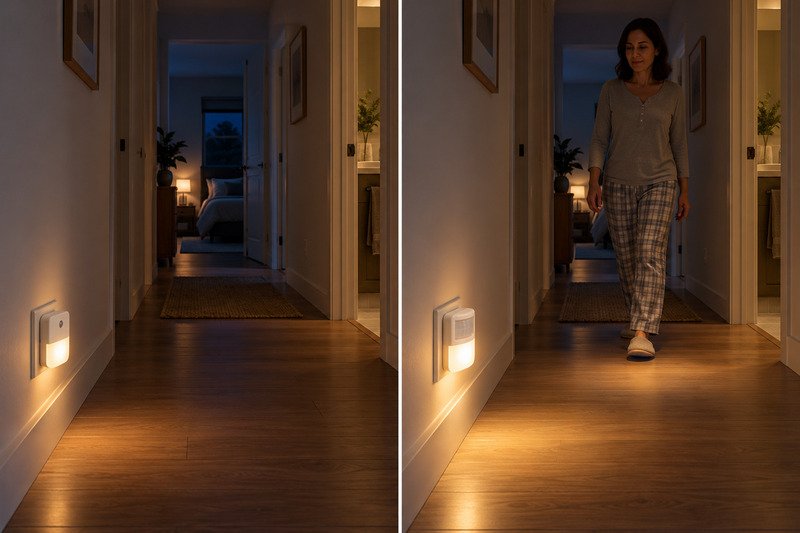
At Chocolamp, I approach sensor selection as a purchasing decision about how people use a room. A household may need a steady reference light in one location and short periods of brighter light in another. I use those differences to build a range that retailers can explain clearly.
Why Can Choosing the Wrong Sensor Mix Create Slow-Moving Inventory?
I would not build a wholesale range around feature count alone. A more advanced sensor can still be the wrong choice for the customer’s daily routine.
I see inventory risk when the product’s operating behavior does not match the reason people buy it. Dusk-to-dawn models suit customers who want steady light in darkness. Motion sensor models suit customers who want light during movement. I separate those needs before choosing price tiers or order quantities.
I start with the customer’s lighting problem
I ask what the end user wants the light to do.
A parent may want a low light that stays on while a room is dark. Another customer may want a bathroom light that stays off until someone approaches. Both customers want convenience, but they expect different behavior.
I would not replace the first product with the second simply because the second has more sensors.
| Customer need | Product I would consider first | Purchasing risk I would check |
|---|---|---|
| The customer wants steady orientation lighting. | I would consider a dusk-to-dawn model. | I would check whether its output feels too bright. |
| The customer wants light only during a short visit. | I would consider a motion sensor model. | I would check activation and switch-off timing. |
| The customer wants dim light with a brighter response. | I would consider a motion-boost model. | I would verify both brightness levels and the operating sequence. |
| The retailer needs a simple opening-price product. | I would evaluate a basic light-sensing model. | I would compare its actual cost and retail margin. |
I avoid treating a proposed range as proven demand
I see a basic model plus an upgrade model as a useful starting structure. I do not treat that structure as proof of what every market will buy.
I would review retailer feedback, sales by SKU and reorder speed before increasing quantities. I would also ask whether weak sales came from the product, its price or an unclear package.
A motion sensor model may be harder to sell if the retailer cannot explain its benefit. A dusk-to-dawn model may generate returns if the package suggests that it detects people. Those problems begin before the customer plugs it in.
Which Sensor-Light Differences Do Buyers Often Overlook?
I find that labels such as “automatic” leave too much unsaid. Two products with that description can behave very differently in the same room.
I check the activation threshold, motion coverage, hold time, installation direction and available modes. I also confirm whether the light stays on throughout darkness, activates only after movement or remains dim before becoming brighter. I want that sequence agreed before I approve samples or packaging.
I turn sensor claims into observable behavior
I prefer a clear operating description to a list of components.
“Light sensor plus PIR sensor” tells me which sensing functions may be present. It does not tell me how the product combines them.
I ask the supplier to demonstrate:
- I check what happens when the room becomes dark without movement.
- I check what happens when someone approaches in darkness.
- I check whether movement can activate the light in a bright room.
- I check how long the light stays on after the last detected movement.
- I check whether further movement restarts the timer.
- I check what the light does when the room becomes bright again.
I confirm conditions behind the numbers
I do not compare sensing distance without knowing the test conditions. The mounting position, direction of travel and surrounding temperature can affect PIR performance.
| Parameter | What I ask the supplier to clarify |
|---|---|
| Activation light level | I ask when the light becomes enabled and when it switches off. |
| Detection distance | I request the tested distance and test arrangement. |
| Detection angle | I ask about coverage with the product installed in its intended orientation. |
| Hold time | I confirm the delay and whether movement resets it. |
| Installation position | I check the required height, direction and clearance. |
| Operating modes | I request a separate explanation for every selectable mode. |
I also check the light sensor’s location. A recessed socket, furniture or a curtain may shade it. A nearby lamp may make the same position appear bright.
I would test these situations during sample approval rather than assume the sensor will behave identically in every home.
How Do Dusk-to-Dawn and Motion Sensor Night Lights Actually Work?
I explain the control logic before discussing features. Buyers can make better choices when they understand what the product senses and what response follows.
I describe dusk-to-dawn lighting as a response to surrounding brightness. I describe a typical PIR night light as a response to movement, often enabled only in darkness. I still verify each model because some offer all-day motion sensing, selectable modes or dim-to-bright operation.
I describe dusk-to-dawn as light sensing
I use “dusk-to-dawn” to describe a light that normally switches on when its surroundings become dark and switches off when they become bright.
The product does not need to know the time of day. A dark indoor room may keep it on during daylight hours.
I would consider this behavior when selecting traditional night lights for continuous orientation lighting. I would still confirm the actual sensor function of the chosen model.
I describe PIR as movement detection
I explain that a passive infrared sensor responds to changes in infrared radiation across its sensing zones. A moving person can create those changes when their temperature differs from the background.
I do not describe PIR as a guarantee that the light knows someone is present. A person who stays still may not keep triggering it.
I also check whether the circuit includes an ambient-light condition. Many indoor models use it to prevent motion activation in bright surroundings, but I do not assume every product does.
| Operating logic | What I expect in darkness without movement | What I expect after movement |
|---|---|---|
| Dusk-to-dawn | I expect the light to remain on. | I expect no movement-related change. |
| Dark-only motion activation | I expect the light to remain off. | I expect temporary illumination. |
| Motion boost | I expect a low background level. | I expect brighter light before it returns to dim. |
| All-day motion activation | I expect the light to remain off. | I expect activation regardless of surrounding brightness. |
I compare electricity use with measurements
I would not promise that every motion sensor model uses less electricity. A motion model may spend less time illuminated, but it still uses power while waiting.
I compare daily energy use as:
Daily energy use = illuminated power × illuminated hours + standby power × remaining hours.
I use measured input power for each state. I also account for dim mode where applicable. Frequent traffic or a long hold time can reduce the expected saving.
For low-power night lights, I would present the measured difference rather than make a large savings claim from the sensor type alone.
Which Night Light Fits Each Customer, Room and Price Tier?
I avoid assigning a sensor to a room by name alone. The customer’s routine, socket position and desired light level can change the better choice.
I would consider dusk-to-dawn models where customers want continuous low-level guidance. I would consider motion models for occasional use where detection coverage is suitable. I treat room recommendations as starting points, then check brightness, placement and operating behavior before assigning the product to a retail tier.
I match the behavior to the activity
I would ask whether someone needs light before moving, during movement or while remaining in one place.
A motion light may work well near a bathroom entrance. It may become frustrating if it switches off while someone remains still inside. A steady light avoids that timing issue, but its brightness still needs to suit the room.
| Location or customer | Option I would evaluate | Detail I would test |
|---|---|---|
| Bedroom | I would evaluate a dim dusk-to-dawn model. | I would check glare from the bed position. |
| Children’s room | I would compare steady and motion-controlled options. | I would ask what behavior the parent expects. |
| Hallway | I would consider either type. | I would assess traffic and socket placement. |
| Entrance | I would consider motion activation. | I would test the approach route and obstructions. |
| Stairs or landing | I would assess coverage carefully. | I would check whether illumination starts before the user enters the dark area. |
| Storage area | I would consider motion activation. | I would test whether shelving blocks the sensor. |
I do not present a plug-in night light as a substitute for adequate stair lighting or required emergency lighting.
I connect the upgrade price to a clear benefit
I may position a basic light-sensing model as an entry product. I may position a motion model as an upgrade. I confirm that structure against real quotations and local retail prices.
For the upgrade, I want a benefit the retailer can demonstrate:
- I show that the light responds when someone approaches.
- I explain the automatic switch-off delay.
- I identify any adjustable brightness or mode selection.
- I describe the situations where those functions help.
When reviewing children’s night lights, I also separate the decorative design from the sensor choice. A cartoon shape does not determine whether continuous or motion-controlled lighting will suit the buyer.
How Should Wholesalers Build a Balanced Sensor Night Light Range?
I prefer a small range with clear differences between products. Several similar models can tie up stock without giving retailers a useful reason to recommend each one.
I would begin with a clearly specified dusk-to-dawn model and a motion sensor alternative where local demand supports both. I would add dual-mode products after reviewing sales and feedback. I would base order allocation on evidence rather than use a fixed percentage for every market.
I give each SKU a defined role
I want the buyer to explain each model in one sentence. That makes assortment decisions, packaging and retailer training easier.
| Range role | Product I would evaluate | Evidence I would review before expanding |
|---|---|---|
| Core product | I would evaluate a simple dusk-to-dawn model. | I would review sell-through and repeat demand. |
| Functional upgrade | I would evaluate a dark-only motion model. | I would review price acceptance and activation complaints. |
| Additional option | I would evaluate dim-to-bright or selectable modes. | I would check whether customers use the extra functions. |
I would keep the initial range focused if retailer demand is uncertain. I would discuss feasible trial quantities with the supplier rather than assume every model supports the same minimum order.
I approve the sensor behavior before the box
I want the packaging to match the approved sample’s actual operation.
I request:
- I ask for a specification sheet covering thresholds, coverage and timing.
- I request a video demonstrating each operating mode.
- I confirm the intended installation position.
- I agree on sample tests and production checks.
- I review instructions for obstructions and unsuitable locations.
- I check that the package clearly distinguishes steady lighting from motion activation.
For multi-functional night lights, I give each mode its own description. I avoid relying on “smart” or “dual sensor” as the main explanation.
I use reorder feedback to adjust the mix
I track sales and complaints by model. I want to know whether customers report excessive brightness, missed activation, short hold time or confusing controls.
I would review those details before changing the range. More motion models will not solve a packaging problem. A cheaper dusk-to-dawn model will not solve a mismatch between continuous lighting and the customer’s expectations.
Frequently Asked Questions
What Is the Main Difference Between the Two Types?
I describe dusk-to-dawn models as responding to surrounding brightness. I describe motion models as responding to movement. I verify the exact sequence because many motion products also use a light sensor.
Do All Motion Sensor Night Lights Include a Light Sensor?
I do not assume they do. I ask whether motion activation works only in darkness, throughout the day or according to a selectable mode.
Which Type Uses Less Electricity?
I compare measured illuminated and standby consumption over the expected daily schedule. Motion control can reduce lighting time, but I cannot identify the lower-energy product from the sensor label alone.
Where Would I Recommend Dusk-to-Dawn Models?
I would consider them for places where customers want a continuous reference light during darkness. I still check output, glare, socket position and nearby light sources.
What Detection Range and Angle Should Wholesalers Request?
I request coverage that suits the intended location, supported by stated test conditions. I test both the expected approach route and the installed orientation rather than choose the largest advertised number.
Should Wholesalers Stock Both Types?
I would consider both when they serve distinct customer needs at workable retail prices. I would start with a focused range and adjust quantities from actual sales and reorder evidence.
Conclusion
I build sensor night light ranges around customer routines, clear operating logic and tested performance. I let sales and reorder evidence guide the final mix.

