
Importing Plug-In Night Lights: What to Confirm About Plugs, Voltage and Compliance
I know a familiar plug and a working sample can feel reassuring. But installation problems or mismatched documents can delay an order that initially looked straightforward.
Before ordering plug-in night lights, I confirm the destination, plug construction, installed lamp position, electrical input rating and supporting documents. I then connect the sample, specification, label and packaging to one approved order version. Descriptions such as “EU plug” or “wide voltage” need further detail before production.
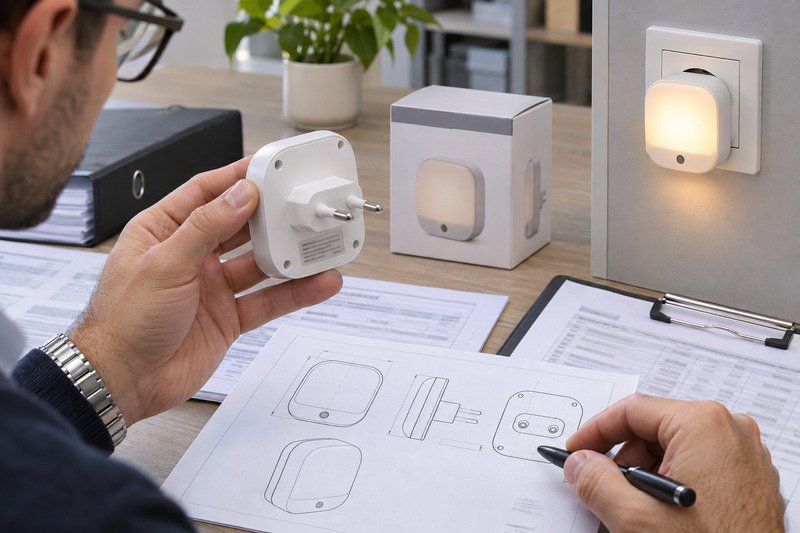
At Chocolamp, customer discussions have included lamps sitting sideways in Italian sockets and Brazilian requests for wide-voltage operation and nonmagnetic pins. I use these experiences to identify practical purchasing questions. I then check the exact product and destination before confirming what the order requires.
Why Is “The Plug Fits” Not Enough to Approve a Night Light?
I do not consider a direct plug-in lamp fully evaluated just because its pins enter a socket. The installed position also affects how the product works.
I check both electrical connection and the lamp’s installed orientation. A night light needs suitable pin dimensions, secure mounting and a usable position for its light, sensor and controls. I request socket photographs and product rear views, then evaluate a sample in the intended arrangement.
I use the Italian example carefully
In one Italian customer discussion, the conventional two-round-pin version could connect to the socket arrangement being considered, but the lamp body sat sideways.
That matters for a product mounted directly in the outlet. A sideways body can change the appearance, light direction or position of the sensor.
I treat this as a specific installation example. I do not describe every Italian socket as having the same orientation.
| Installation detail | What I confirm |
|---|---|
| Pin arrangement | I compare the product’s rear view with the intended socket. |
| Body direction | I check whether the lamp sits in the approved position. |
| Light direction | I check where the illuminated surface points. |
| Sensor exposure | I check whether furniture or the housing blocks the sensor. |
| Control access | I confirm that the switch remains accessible. |
| Outlet clearance | I check whether the body obstructs an adjacent outlet. |
I approve the physical arrangement
I request clear rear and side photographs alongside the plug drawing.
For models selected from our traditional night lights range, I still confirm the exact export version. A catalog photograph may not show every available pin arrangement.
I want the buyer to approve a sample installed in the intended position. A drawing helps explain dimensions, while a physical check reveals practical issues around the socket and lamp body.
What Should Brazilian Buyers Confirm About Input Ratings?
I understand why Brazilian importers ask for wide-voltage products. But the input range needs to describe the supplied electrical design, rather than only the requested packaging text.
For distribution across Brazil’s 127V and 220V supply areas, I consider a properly evaluated wide-input model. I confirm the complete AC voltage and frequency rating for the ordered version, then check that the sample, rating label and supporting evidence agree. A brief power-on demonstration cannot validate the entire range.
I separate a catalog specification from final approval
The A66 sensor night light catalog lists a 100–240V input range, 0.5W power, four LEDs and an ABS housing. It describes automatic operation according to ambient light.
It also offers 4000K or 6500K light. I would treat those as available versions unless the supplier separately confirms a user-selectable function.
The available catalog information does not establish every export configuration or state the frequency. I therefore need written confirmation before completing the order specification.
I ask for the missing information explicitly
My electrical confirmation includes:
- I identify the exact model and circuit version.
- I confirm the intended AC input range.
- I request the rated frequency.
- I compare the product label with the specification.
- I review evidence supporting operation across the declared range.
- I confirm the selected light-color version.
- I identify any differences between European and Brazilian configurations.
I do not add “50/60Hz” simply because it appears on another night light.
I compare performance under defined conditions
I ask how light output, sensor operation and temperature have been evaluated at relevant supply conditions.
I also want the assessment to correspond to the configuration being purchased. A housing photograph can help identify the design, but it cannot establish electrical performance.
If the supplier proposes a circuit change, I review its effect on the specification and supporting evidence before approving the substitution.
How Do I Confirm Plug-Pin Materials and Corrosion Requirements?
I have received Brazilian requests for nonmagnetic pins and materials that avoid rust problems. I turn those requests into a written specification before confirming the product.
I ask for the pin base material, surface treatment and relevant supporting evidence. I do not treat a magnet check as proof of alloy composition or corrosion resistance. Where corrosion performance matters, I agree on the intended conditions, test method and acceptance criteria for the ordered version.
I define the material behind the description
A request for “good-quality pins” leaves too much open.
I want the supplier to identify what the pins are made from and whether a coating is applied. I also check dimensions, construction and how the assembly is secured to the lamp.
| Purchasing description | Detail I request |
|---|---|
| Nonmagnetic pins | I request the specified base material and verification basis. |
| Rust-resistant construction | I request the material, finish and relevant evidence. |
| Plated pins | I request the coating specification and underlying material. |
| Suitable for humid conditions | I clarify storage and intended indoor-use conditions. |
| Tested for corrosion | I request the method, conditions, results and acceptance criteria. |
I avoid claims that the available information cannot support
The A66 catalog information available for this review does not identify the pin alloy, coating or corrosion-test results.
I therefore would not advertise brass pins, a particular plating or salt-spray performance without confirmation.
I also keep the destination’s applicable requirements in the review. A customer’s magnet test does not replace the assessment of the actual plug construction.
I connect the requirement to storage and use
If the buyer distributes in humid or coastal areas, I ask what conditions the packed product may encounter.
I distinguish storage expectations from the intended operating environment. Corrosion evidence does not automatically establish outdoor suitability.
I record the agreed construction and performance requirements so the buyer, factory and inspection team can check the same version.
How Should Importers Match Compliance Documents to the Actual Product?
I do not approve a document package by counting certificates. I need to understand whether the evidence corresponds to the night light being ordered.
I compare the model identification, photographs, ratings, circuit, plug construction and material details with the supporting documents. For EU projects, I also review the importer’s applicable verification duties. A report for a similar-looking lamp does not automatically establish coverage for another configuration.
I check the relationship between the report and the order
A supplier may use one model name for several export versions. I ask how those versions are distinguished.
My document comparison covers:
- The model number and any listed variants.
- Product photographs and construction descriptions.
- Rated electrical input.
- Plug configuration.
- Relevant components and materials.
- Any explanation of model-family coverage.
- Differences introduced after testing.
For multi-functional night lights, I also identify the supplied functions. A different sensor or operating circuit may need review before the evidence can support that version.
I recognize the EU importer’s role
Under the EU Low Voltage Directive, importers must verify that the manufacturer has completed the appropriate conformity assessment and prepared technical documentation. They must also check the required marking, documents and identification information.
Importers have obligations concerning destination-language instructions and safety information. They must retain the EU Declaration of Conformity for ten years and ensure technical documentation can be made available to the authorities.
I treat those duties as part of order preparation. The applicable requirements for the complete product still need to be identified, including other relevant legislation.
I review Brazil separately
I do not use EU documents as proof of Brazilian compliance.
I ask the importer and a competent local specialist to confirm the actual product classification and applicable obligations. I distinguish documents for a plug or component from evidence covering the finished lamp.
Product images, videos and sales sheets support identification and selection. I use them alongside the appropriate conformity evidence.
How Do I Put the Approved Configuration Into One Order Version?
I want purchasing, production and inspection to work from the same instructions. Separate approvals scattered across emails can leave the final configuration unclear.
I connect the approved sample, plug drawing, electrical rating, materials, labels, packaging and document references to one order revision. I record outstanding points and require approval before relevant substitutions. Before shipment, I compare production goods and documents against those references.
I prepare a complete approval record
| Order element | What I record |
|---|---|
| Destination | I list the countries covered by the order. |
| Model and version | I identify the circuit, function and selected configuration. |
| Plug | I attach the approved drawing and installed-position reference. |
| Input rating | I confirm AC voltage and frequency in writing. |
| Pin construction | I record the material and surface treatment. |
| Label | I identify the approved rating-label artwork. |
| Instructions | I identify the approved content and language versions. |
| Packaging | I confirm structure, artwork and carton arrangement. |
| Documents | I list the relevant declarations, reports and coverage explanations. |
| Sample | I identify the retained approval reference. |
I resolve open points before production
For A66, I would complete the frequency confirmation, exact plug variant, pin specification and document review before treating the configuration as approved.
The same approach applies when selecting children’s night lights. A decorative design still needs an identifiable electrical and packaging version.
I review changes before accepting them
I ask the supplier to explain proposed substitutions and their effect on performance, documents and timing.
I then update the approval record where necessary. Before shipment, I arrange checks against the current version so the delivered product follows the agreement.
Conclusion
I confirm the installed position, electrical rating, pin construction and document coverage together. One approved order version gives production and inspection a clear reference.

