
From Approved Sample to Bulk Production: How to Keep Night Light Quality Consistent
I know a good sample can give buyers confidence. But unclear production instructions or outdated artwork can still create differences across a bulk order.
I connect sample approval with written specifications, final artwork, inspection instructions and shipment-release records. I retain matching samples, confirm the ordered configuration and review corrections before shipment. For repeat orders, I carry those approved requirements forward and assess any proposed changes before accepting them.
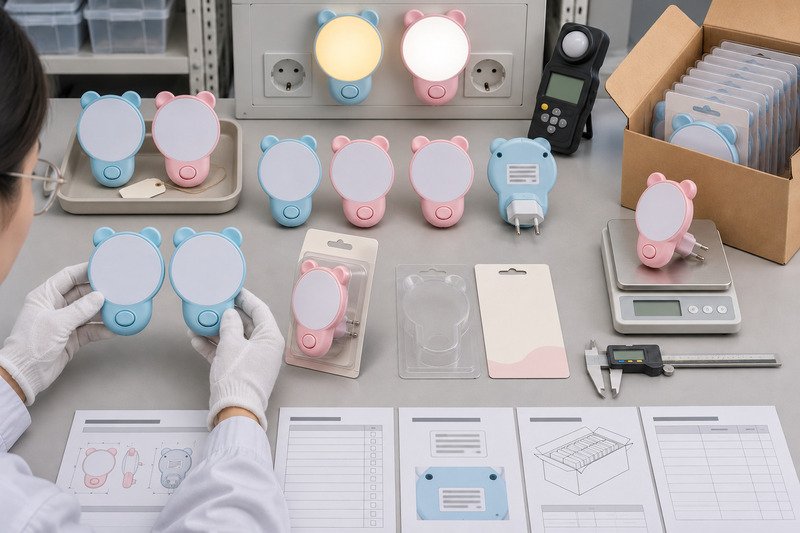
At Chocolamp, customers normally evaluate the samples we send before confirming an order. I prepare one or two matching samples before dispatch so I retain a physical reference. I then use the customer’s feedback to clarify the production requirements, packaging files and inspection arrangements.
Why Do I Retain Matching Samples Before Dispatch?
I want a reference available when the customer finishes testing. Without one, a later discussion about color, operation or assembly can depend too heavily on photographs and memory.
Before sending samples, I prepare one or two additional units of the same version. I record the model, color, function and plug configuration. I then connect the customer’s approval to that reference and clarify any changes requested after testing.
I identify the version being evaluated
I do not rely on the model number alone when several versions exist.
For example, the buyer may be evaluating a particular housing color, plug arrangement or light function. I need to know which combination was sent and which requirements the customer accepted.
| Sample detail | What I record |
|---|---|
| Model | I identify the product being evaluated. |
| Housing color | I record the supplied color. |
| Function | I identify the operating modes. |
| Plug | I record the supplied configuration. |
| Reference | I connect the sample with its specification and photographs. |
| Approval | I retain the customer’s confirmation and requested changes. |
I clarify the limits of approval
If the buyer approves the lamp but has not reviewed the retail packaging, I keep packaging approval open.
If the customer requests a change after testing, I update the written specification and discuss whether another sample is needed.
I describe our retained units as matching reference samples. I would only call them formally signed or sealed samples if the parties actually use that approval system.
How Do I Turn a Z-035 Sample Into Production Specifications?
I use the physical sample to support the discussion, but it cannot communicate every electrical, material and packing requirement by itself.
For Z-035, I confirm the housing color, selectable 3000K and 5000K light, European two-round-pin plug, electrical input and materials. I also record the packing arrangement. Where measurements become acceptance criteria, I agree on tolerances and methods before inspection.
I put the configuration in writing
For the Z-035 order setup described here, I use the following production reference.
| Specification item | Order requirement or reference |
|---|---|
| Model | Z-035 |
| Housing color | As confirmed for the order |
| Light modes | Selectable warm and white light |
| Color temperatures | 3000K and 5000K |
| Plug | European two-round-pin configuration |
| Listed LED power | 1.2W |
| Input | 100–240V, 50/60Hz |
| Housing materials | HIPS and PP |
| Product reference weight | 38.4g |
| Product with blister reference weight | 46g |
| Sliding-card blister dimensions | 13 × 9.2 × 8cm |
| Inner-box quantity | 48 units |
| Inner boxes per carton | Six |
| Total per carton | 288 units |
I define how the reference will be used
I do not treat a nominal weight as an automatic pass-or-fail limit.
If weight, dimensions or color temperature will determine acceptance, I discuss the measurement method and acceptable variation with the customer and factory.
I also distinguish visual comparison from material or electrical verification. A lamp can resemble the sample without that resemblance establishing its polymer grade or performance across the full input range.
When buyers select children’s night lights, I apply the same principle: the decorative appearance and the technical specification both need clear references.
How Do I Control Labels, Packaging and Final Files?
I know artwork often changes during an order. A small revision can become a production problem if the printer and factory receive different versions.
I identify the final label, packaging artwork and packing instructions before production. I check their content against the ordered configuration and review the printed dimensions at actual size. Customer-designed artwork still needs an appropriate content and marking review.
I review the rear label as part of the product
For this Z-035 setup, the customer designs the rear label. I coordinate its review against the supplied version and available label space.
My review covers:
- I check the model identification and electrical ratings.
- I review applicable identification and traceability information.
- I check symbol artwork, placement and readability.
- I confirm the printed label dimensions.
- I identify the approved file version.
- I communicate any revision to the parties using it.
I check each marking against its own requirements
For CE marking, EU guidance generally specifies a minimum height of 5mm unless applicable product rules provide otherwise. I also preserve the official proportions.
I do not apply that dimension to every symbol on the label.
Our stated artwork requirement for the crossed-out wheeled-bin marking is a 7mm minimum. I record that as the project requirement, then check the exact symbol drawing and measurement basis.
I clarify whether the measured height includes the lower bar and review the applicable marking requirements before final approval. I do not present 7mm as a universal minimum for every product or symbol.
I connect the package with the final lamp
I check the actual product inside its blister packaging. I review fit, appearance, identification and the agreed carton arrangement.
The same file-control approach applies to products from our traditional night lights range. Familiar packaging still needs a clearly identified final version.
What Should a Third-Party Inspection Establish Before Shipment?
I want the buyer and inspector to agree on the purpose of the visit. An inspection report is more useful when its checks and release conditions are defined beforehand.
For first orders, customers generally arrange an independent inspection and review the report before shipment. I provide the product reference and approved requirements. I agree on the inspection scope, sampling approach, acceptance criteria and release authority for the particular order.
I describe the actual checks
In the first-order experience discussed here, inspection focuses on appearance and whether the lamps light and operate.
I do not describe those checks as a full laboratory evaluation.
| Inspection area | What I clarify in the brief |
|---|---|
| Appearance | I identify the approved colors, finish and relevant defect criteria. |
| Assembly | I specify the parts and visible construction to compare. |
| Plug | I identify the ordered configuration. |
| Function | I state which operating modes must be checked. |
| Label | I provide the final artwork reference. |
| Packaging | I identify the approved pack and printed files. |
| Quantity | I confirm the packing arrangement and carton quantities. |
| Release | I identify who reviews findings and authorizes shipment. |
I agree on sampling rather than assume it
I confirm the sample sizes and acceptance approach with the customer and inspection provider.
I do not claim that every unit is inspected. I also do not describe our process as using a fixed AQL plan unless that plan has been agreed for the order.
For Z-035, I clarify whether the two light modes receive a visual comparison or instrument measurement. Those are different checks.
Appearance and light-up inspections support the shipment decision. They do not replace the applicable electrical, EMC or other conformity evidence for the product.
How Do I Handle Burrs, Stains and Rework Findings?
I occasionally encounter small burrs or stains during appearance checks. I want the correction and its verification to be clear before the customer decides on shipment.
I record the finding, identify the affected scope and agree on the required correction. I then confirm the result through the evidence or follow-up check the customer requires. I assess the location and severity before treating a finding as a routine appearance issue.
I assess the finding before choosing the response
A small stain may need cleaning. A burr may need removal. But I do not assume that every burr is cosmetic.
A sharp accessible edge or a finding near the plug needs appropriate assessment before release.
My correction review follows these steps:
- I record the defect and its location.
- I clarify the affected units or inspection scope.
- I agree on the proposed corrective action.
- I confirm how the result will be checked.
- I provide the required evidence.
- I retain the customer’s release decision.
I distinguish completing rework from accepting it
Cleaning a stain records an action. Checking the cleaned surface establishes whether the result meets the agreed requirement.
I use the same distinction after burr removal. I want confirmation that the correction has not damaged the finish, fit or structure.
Depending on the finding, the customer may request photographs, another check or a further third-party inspection.
If the issue involves electrical safety, a component substitution or a specification mismatch, I arrange the relevant assessment before release. I do not close it through appearance photographs alone.
How Do I Carry Approved Requirements Into Repeat Orders?
I want repeat orders to benefit from the work already completed. That requires a clear reference to the previous approved version and a review of any changes.
I reference the approved specification, sample, artwork and packing instructions when reviewing a reorder. I reconfirm the colors, functions, plug, materials and labels. I assess proposed substitutions and update the records where needed so the factory and customer use the same current requirements.
I begin with a comparison
| Reorder item | What I reconfirm |
|---|---|
| Product configuration | I check the model, colors and operating modes. |
| Electrical version | I confirm the input rating and plug arrangement. |
| Materials | I identify any proposed material or component changes. |
| Label | I check the current approved artwork. |
| Packaging | I confirm structure, printed files and carton packing. |
| Inspection | I agree on the checks and release conditions for the new order. |
I review changes before accepting them
A substitute component may be available, but I need to understand its effect before approval. I also review whether a change affects the supporting assessment or documents.
For multi-functional night lights, I pay particular attention to operating modes and controls because a familiar housing can contain a different functional version.
I retain the revised approval and communicate it to production and inspection. That gives the next order an identifiable standard rather than a general instruction to repeat the last shipment.
Conclusion
I connect retained samples, written specifications, approved files and inspection records. Clear correction and release decisions then carry that standard into production and repeat orders.

