
How to Build a Night Light Product Range Without Overstocking
I know more designs can make a catalog attractive. But every extra model can add another stock commitment before the buyer knows what customers will reorder.
I build a night light range by identifying gaps in the existing selection, combining basic and feature models, and checking MOQ by model, color and packaging. I compare total purchasing commitments at trial and standard quantities, then use sales, remaining stock and incoming orders to guide expansion.
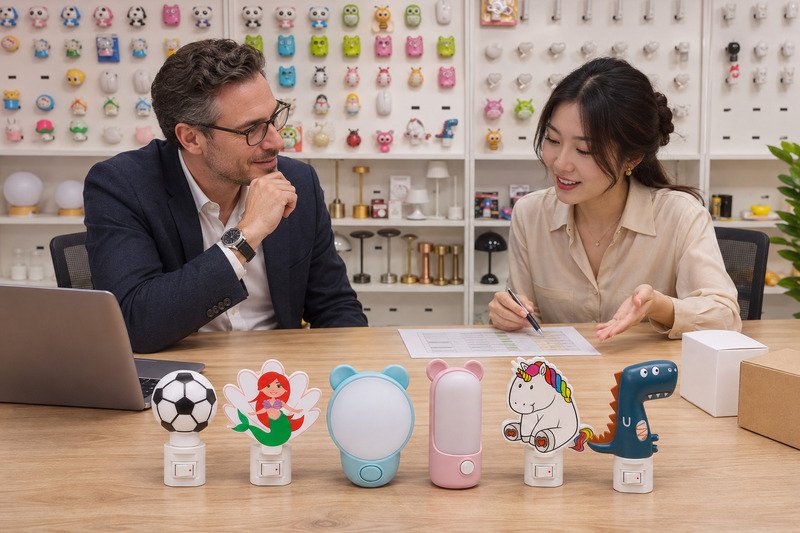
At Chocolamp, I want each new model to have a clear purpose. A wider selection can help an importer serve more customers, but the purchasing commitment must remain manageable. My starting point is the customer’s current range, followed by the quantity and packaging conditions behind each proposed addition.
What Would a New Model Add to Your Existing Range?
I do not begin by recommending every available design. A product can look different while serving almost the same need as something the buyer already stocks.
I review the customer’s existing models, functions, price positions and sales channels before suggesting additions. I look for a clear gap that a new product can fill. That might be an affordable basic model, a different control function or a decorative option for a specific customer group.
I start with the current selection
I ask buyers to share their catalog, product links or a short list of existing models. I then compare what they already offer with what they want to achieve.
| What I review | Question I ask |
|---|---|
| Existing functions | Does the range already cover manual switches and automatic lighting? |
| Price positions | Is there room for an entry product or a functional upgrade? |
| Designs | Would another shape serve a different customer? |
| Sales channels | Which retailers or distributors would buy the addition? |
| Current stock | Would the new model compete with inventory already waiting to sell? |
I give each addition a specific role
If a customer already carries several basic switch models, I would need a reason to recommend another similar product.
I might instead review a light-sensing model from our traditional night lights range. If automatic lighting is already covered, selectable light colors or another useful function may offer a clearer difference.
In discussions with Greek importers, I have encountered requests for several models at around 1,500–2,000 pieces per model. I treat that as a customer purchasing preference. I still check whether each proposed product can support the requested quantity and packaging.
How Do I Balance Basic Models With Feature Models?
I know a range needs competitive prices. But filling every position with similar low-priced products can leave retailers with little reason to recommend one over another.
I combine basic night lights with selected models that offer a clear functional difference. I use the buyer’s current range, budget and channel to decide the balance. I do not apply one fixed percentage to every importer or assume a higher-priced model will automatically sell better.
I distinguish price variety from product variety
I want the buyer to explain why each model belongs in the range.
My selection questions include:
- Does the basic model meet a clear entry-price need?
- Does the feature model offer something customers can understand?
- Can the retailer demonstrate that difference?
- Does the expected retail price leave enough room for the channel?
- Would fewer models cover the same needs?
A different shape may be useful, but I also look for differences in operation.
I use Z-035 as a functional example
Z-035 offers selectable warm and white light. I see that as a useful reason to consider it alongside a basic night light because one product can create two different lighting atmospheres.
I would demonstrate both settings rather than describe it only as a cartoon design.
For a buyer evaluating children’s night lights, that combination of appearance and selectable light color may justify further review. I would still ask the customer to assess the sample and intended selling price.
I keep the first selection focused. A feature is useful when it supports the buyer’s offer, and its value needs confirmation through local feedback and sales.
I find that color choices can quietly increase an order. Buyers need to know whether the minimum applies to the model, each color or every packaging version.
For the Z-035 arrangement described here, I can support 1,000 blue units and 1,000 pink units using one shared packaging design. That creates a 2,000-piece order of one model. I confirm the applicable quotation and production conditions before treating this arrangement as an approved order plan.
I calculate the full quantity before adding variants
I use a simple breakdown so the buyer can see the stock commitment.
| Model | Housing color | Quantity | Packaging arrangement |
|---|---|---|---|
| Z-035 | Blue | 1,000 pieces | One shared design |
| Z-035 | Pink | 1,000 pieces | The same shared design |
| Total | Two colors | 2,000 pieces | One packaging design |
This arrangement gives the buyer two color choices without a separate 2,000-piece commitment for each color.
I do not extend that condition automatically to other products. Different models cannot necessarily be combined to reach one MOQ.
I confirm that the package describes the supplied product accurately. If it serves both housing colors, I agree on how the packed version will be identified where needed.
I also review:
- The quantity of each color.
- The approved packaging artwork.
- Any color identification labels.
- The packing arrangement inside cartons.
- Any separate barcode requirements.
- The conditions for future reorders.
If the buyer wants different printed packaging for blue and pink, I reassess the printing quantities and cost.
I want the buyer to understand the MOQ at every relevant level before adding another version.
How Should Buyers Compare a Trial Order With 5,000 Pieces?
I understand why a lower unit price attracts attention. But a larger quantity can require more cash and leave the buyer responsible for more untested stock.
I compare the total expenditure and stock exposure at each quantity. For Z-035, the usual order quantity is 5,000 pieces, while an initial trial of 2,000–3,000 pieces can be considered. A smaller custom-packaging order may have a slightly higher unit price because setup costs are spread across fewer units.
I request comparable quotations
I ask for prices based on the same product, packaging and commercial terms.
| Quantity | Total product expenditure | Share of a 5,000-piece order’s units |
|---|---|---|
| 2,000 pieces | 2,000 × confirmed trial unit price | 40% |
| 3,000 pieces | 3,000 × confirmed trial unit price | 60% |
| 5,000 pieces | 5,000 × confirmed standard unit price | 100% |
I do not assume expenditure falls by exactly the same percentage as quantity. Unit prices and separately charged costs may differ.
I compare the complete commitment
My review includes the goods, packaging setup, freight and other costs the buyer needs to budget.
I also ask what evidence supports the extra units. A buyer with regular replenishment demand may have a stronger basis for 5,000 pieces than a buyer introducing the model for the first time.
At 2,000 pieces with custom packaging, Z-035 can carry a slightly higher unit price because plate-making costs are allocated across fewer units. I explain that difference through the actual quotation.
I would consider paying more per unit acceptable when the smaller order better fits the buyer’s testing budget. The decision depends on the total commitment and replenishment plan.
What Can Repeat Orders Tell Me About Range Expansion?
I value reorder history, but I cannot use it to calculate a customer’s sales speed without their receiving dates, sales records and remaining stock.
I use repeat orders as evidence that purchasing continued. Before recommending expansion, I also review sales by model and color, stock remaining, incoming goods and replenishment timing. Those figures help me distinguish demand for the existing model from a reason to introduce another one.
I keep the Z-035 order history accurate
One European importer first ordered Z-035 in September 2025, with shipment around October.
| Order | Placement | Shipment |
|---|---|---|
| First order | September 2025 | Around October 2025 |
| Second order | April 2026 | May 2026 |
| Third order | May 2026 | July 2026 |
I can say the customer continued buying the model. I do not have their complete stock balances, sales rate or exact receiving dates, so I cannot claim that the order history proves overstocking was avoided.
I ask for inventory information before adding models
I want to know:
- How many units sold by model and color?
- How many remain available?
- What quantities are already on order?
- When will incoming shipments arrive?
- Which retailers are requesting replenishment?
- What evidence supports a new function or design?
If blue sells faster than pink, I may review the next color split before proposing another model.
If customers request a different application, I may evaluate an addition from our multi-functional night lights range.
I treat replenishing an established product and expanding the assortment as two separate purchasing decisions.
What Should Buyers Check Before Approving the Product Mix?
I want purchasing and sales to agree on the purpose of each model before production. That gives the first order a clearer review process.
I confirm each model’s role, quantity breakdown, packaging and approved specification before ordering. I also agree on the information that will guide replenishment. A useful assortment checklist connects the initial stock commitment with the buyer’s next purchasing decision.
I review the order on one sheet
| Checkpoint | What I confirm |
|---|---|
| Product role | Each model adds a defined price, function or design choice. |
| Existing stock | The buyer has reviewed overlap with current inventory. |
| MOQ basis | Minimums are clear by model, color and packaging. |
| Color split | Quantities reflect the testing plan. |
| Packaging | Shared designs and identification methods are approved. |
| Samples | The final configuration matches the written specification. |
| Expenditure | Trial and standard quantities have comparable quotations. |
| Replenishment | Production and shipping timing inform the purchasing plan. |
| Review data | Sales, remaining stock and incoming orders will be tracked. |
I agree on what would justify expansion
Before the launch, I ask the buyer to define what they want to learn.
The first order may test acceptance of selectable light colors, a new design or a different retail price. I keep that question visible when reviewing results.
If sales support the model but one color remains slow, I adjust the color mix. If retailers identify an unmet need, I review a complementary model.
I want each new commitment to follow information the previous order helped collect.
Conclusion
I build manageable ranges through distinct product roles, clear MOQ conditions and visible purchasing commitments. Sales and inventory evidence then guide replenishment and expansion.

