
I know a cheaper quotation can look attractive. But when two night lights look alike, hidden differences can turn a small saving into complaints, returns or inconsistent stock.
I compare similar-looking LED night lights by their LEDs, plastic grades, housing structure, color process, plug pins, internal components and testing requirements. These details can explain price differences that photos cannot show. I also align quantity, packaging and trade terms before deciding whether two quotations offer comparable value.
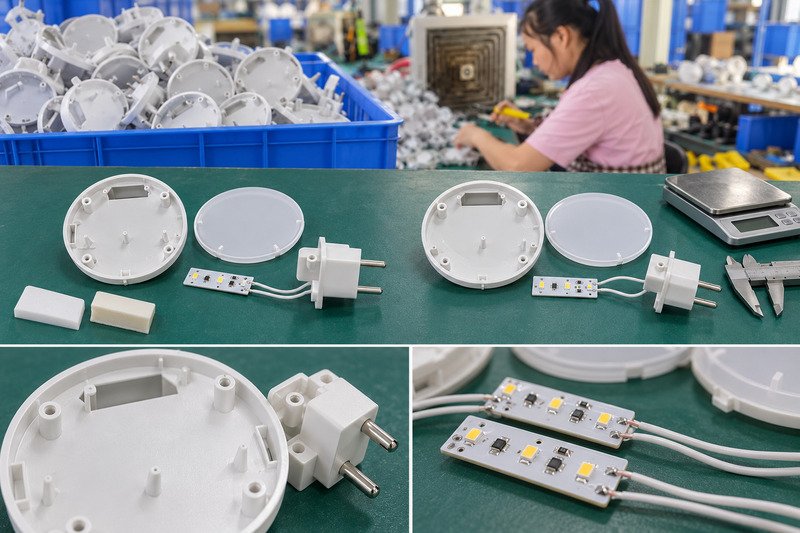
In my work at Chocolamp, I want buyers to understand what they are paying for. A higher price needs a clear explanation. A lower price deserves the same review. I start with the specification behind each quotation, then look at whether the differences matter to the buyer’s market.
Why Might Identical-Looking Night Lights Not Offer the Same Quality?
I cannot judge a night light’s construction from its front photo. A familiar shape can hide differences that affect appearance, performance and production consistency.
I treat appearance as one comparison point, not a complete specification. Two matching designs may use different LEDs, plastics, electronics, plug assemblies and finishes. I need to check those details before deciding whether the products have the same quality or simply share a similar shape.
I separate the design from the construction
I can use a product photo to discuss style, color and shelf appeal. I cannot use it to confirm the plastic grade, the circuit design or the strength of the plug assembly.
For example, when I discuss children’s night lights, the cartoon shape helps buyers select a design. I still need a separate agreement on the electrical function, materials and packaging.
| What I can compare visually | What I need to confirm separately |
|---|---|
| I can compare the general shape. | I need the housing material and structural specification. |
| I can compare the visible color. | I need the color reference and manufacturing process. |
| I can see that the sample lights up. | I need the agreed brightness, color temperature and operating requirements. |
| I can inspect the external plug shape. | I need its material, dimensions and fixing method. |
| I can review the retail box design. | I need the packaging material and packing arrangement. |
I do not assume the higher price proves better quality
I also consider commercial differences. A quotation may reflect a smaller quantity, more detailed packaging or different delivery terms.
I therefore ask two questions: What is different, and does that difference support my customer’s requirements?
A painted finish may suit a particular retail range. A molded-color finish may meet another buyer’s needs at a lower processing cost. I want the quotation to explain that choice rather than leave the buyer guessing.
Which Cost-Cutting Details Do Buyers Often Miss?
I understand why buyers check size, wattage and price first. But those details alone can leave important material and production changes unnoticed.
I look beyond the shape and rated power to check plastic grade, recycled content, housing weight, LEDs, plug construction, electronics and surface treatment. I do not assume every saving reduces quality. I ask whether the saving changes an agreed requirement or removes something the buyer needs.
I distinguish a simpler specification from an undisclosed change
I can help a buyer reduce costs through a simpler box, fewer color options or a finish that needs fewer production steps. Those choices can be reasonable when both sides approve them.
I take a different view when the quotation promises one construction and production uses another. The problem is the gap between the agreed specification and the delivered goods.
I pay particular attention to these points:
- I ask whether “ABS housing” identifies a specific grade or only the polymer family.
- I check whether the supplier has declared recycled content or a material blend.
- I compare net product weight without the retail box or accessories.
- I confirm whether the LED specification includes more than the package size.
- I ask whether the plug-pin description covers the base metal and any coating.
- I check whether a painted sample will be supplied with the same finish in production.
- I confirm which inspections and tests the quotation includes.
I use simple checks as signals, not final proof
I may investigate a weight difference, an uneven finish or a strong smell. I do not treat any one of those observations as proof of a particular material or safety problem.
I also avoid calling all recycled plastic poor quality. Its suitability depends on the feedstock, grade, processing controls and required performance. Virgin material also needs a defined grade and proper production control.
For me, a useful cost discussion ends with an agreed specification. A vague promise of “the same quality” gives neither side enough detail to control the order.
How Do LEDs, Housing Materials, Surface Finishes and Plug Pins Affect Price?
I cannot explain a price gap properly with a single material label. Each part has specifications that can change both its cost and its suitability.
I review LED output and consistency, the exact plastic grade, the coloring process and the complete plug assembly. I also consider the circuit that operates the LEDs. These choices affect the manufacturing cost, but I judge their value against the product’s intended use and agreed requirements.
I compare LEDs under the same conditions
I ask buyers to compare samples at the same supply voltage and in the same surroundings. Camera exposure can make different lights appear equally bright.
I want the LED requirements to address:
- I confirm the LED type and quantity.
- I agree on the required light output or a suitable measurement method.
- I confirm color temperature and acceptable variation.
- I check how evenly the housing spreads the light.
- I ask what evidence supports any operating-life claim.
I do not treat the LED supplier’s life estimate as a guarantee for the complete night light. The circuit, operating temperature and other components also matter.
I specify the plastic grade and color process
I use PC, ABS and PP as starting points for discussion. I do not rank them as universally good, better and best. Their suitability depends on the grade, part design and required performance.
I also separate the plastic material from its visible finish.
| Color process | How I describe it | What I include in the cost review |
|---|---|---|
| Molded-in color | I specify color that is incorporated into the plastic before molding. | I review resin, colorant, color matching and molding requirements. |
| Spray painting | I specify a coating applied after molding. | I review preparation, paint, application, drying or curing, handling and inspection. |
I generally expect spray painting to add processing cost to a comparable housing. I do not apply a fixed premium because the paint system, coverage, order size and finish requirements differ.
I review the complete plug assembly
I consider the conductive metal, coating, dimensions, mechanical strength and fixing method together.
Copper conducts electricity well, but I do not accept “copper pins” as a complete quality specification. I still need to know whether the assembly fits the intended market and remains secure in the product.
I use the same approach when comparing traditional night lights. A simple exterior does not remove the need to define the electrical parts behind it.
Why Do Weight, Wall Thickness, Painting and Flame Retardancy Matter?
I know buyers cannot see every structural detail during a sample review. But a weight reading or glossy surface can also create the wrong impression.
I use weight and wall thickness as control points, not automatic quality scores. I assess painting against agreed appearance and durability requirements. For flame retardancy, I request a defined material grade and relevant evidence. None of these checks alone establishes the safety or quality of the complete night light.
I use weight to monitor an approved construction
I record the approved sample’s net weight and agree on a suitable production tolerance. I exclude packaging so that the comparison stays useful.
A weight change can suggest a different material, component or construction. It tells me to investigate. It does not identify the cause by itself.
I also correct a common assumption about molds. The same external shape can come from different internal tooling. But I cannot freely change the designed wall thickness in an unchanged mold simply by using less plastic. The cavity and core geometry define that thickness.
I ask for critical dimensions or section drawings when the structure needs closer control.
I inspect the finish against its purpose
I do not describe painting as an automatic quality upgrade. I ask what appearance the buyer needs and whether the coating performs as agreed.
| Feature | What I check | What I avoid assuming |
|---|---|---|
| Product weight | I compare it with the approved construction. | I do not assume heavier always means better. |
| Wall thickness | I review critical sections, ribs and fixing points. | I do not judge the whole housing from one measurement. |
| Painted finish | I check color, gloss, coverage and agreed adhesion requirements. | I do not assume gloss proves durability. |
| Molded-in color | I check shade, consistency and surface defects. | I do not assume an unpainted part is a lower-quality part. |
| Flame-retardant material | I request the grade, applicable parts and supporting evidence. | I do not treat a material claim as proof for the complete product. |
I ask what “flame-retardant” actually means
I want the supplier to identify which part uses the material and which rating or test supports the claim.
For example, I check the test thickness when reviewing a UL 94 material rating. I also keep material evidence separate from finished-product evaluation. A recognized plastic does not by itself establish that the complete night light meets every applicable requirement.
What Should Buyers Request Before Comparing Night Light Quotations?
I find price comparisons difficult when suppliers quote against different assumptions. A shared specification gives me a clearer way to explain both savings and extra costs.
I recommend requesting a specification sheet, approved sample, material details, net weight, color process, plug specification, LED requirements and relevant test documents. I also align packaging, quantity and commercial terms. I then compare each quotation against the same requirements and identify any exceptions before approval.
I put the comparison basis in writing
I prefer one clear comparison sheet to several disconnected emails. I use it to show what is included, what remains unconfirmed and where an alternative differs.
| Comparison item | What I request or confirm |
|---|---|
| LED specification | I confirm type, quantity, light output, color temperature and consistency requirements. |
| Housing material | I request the polymer, grade and declared recycled-content basis. |
| Product weight | I record net weight and an agreed production tolerance. |
| Wall thickness | I identify critical sections or structural dimensions where needed. |
| Color process | I confirm molded-in color, painting or another specified process. |
| Surface finish | I agree on color, gloss, texture and acceptable appearance defects. |
| Plug assembly | I request material, coating, dimensions and fixing details. |
| Internal components | I review relevant PCB, switch, sensor and wiring information. |
| Flame retardancy | I identify applicable parts, material requirements and supporting evidence. |
| Testing | I agree on required safety, temperature, function and inspection checks. |
| Packaging and terms | I align box specifications, quantity, trade terms and payment conditions. |
I match documents to the quoted version
I ask whether reports and declarations apply to the actual model, configuration and materials being offered.
I also use internal photos as supporting information. I do not expect a photo to reveal every component rating or prove electrical safety.
For multi-functional night lights, I add the relevant operating requirements. A sensor function needs clearer instructions than simply “automatic,” and different modes need agreed behavior.
Before I approve production, I want three things recorded:
- I identify the approved sample and specification revision.
- I list any accepted alternatives or unresolved points.
- I require confirmation before changes to agreed materials, components or finishes.
Frequently Asked Questions
Why Can Two Identical-Looking LED Night Lights Have Different Prices?
I first check whether their specifications match. LEDs, plastic grades, finishes, plugs, electronics and inspection requirements may differ. I also compare order quantity, packaging and trade terms because those conditions can affect the quotation.
What Is the Difference Between Virgin and Recycled Plastic?
I describe virgin plastic as resin that has not previously been used in a finished product. Recycled material comes from recovered material streams. I assess the actual grade and performance requirements rather than deciding suitability from those labels alone.
Why Does a Spray-Painted Night Light Usually Cost More?
I include the additional preparation, coating, drying or curing, handling and inspection in its cost. I still check the actual process because the premium varies. A painted finish does not automatically improve the LEDs, electronics or housing structure.
How Does Plug-Pin Material Affect Quality and Cost?
I consider conductivity, strength, manufacturing method and coating costs. I also check dimensions and how the pins are secured. I cannot judge the complete assembly from the metal name alone.
Does a Heavier LED Night Light Always Mean Better Quality?
I do not use weight that way. A heavier product may have a different design or material. I use weight to monitor an agreed construction, then investigate differences alongside structural and functional checks.
What Should I Confirm Before Comparing Quotations?
I align the product specification, finish, packaging, quantity, testing and commercial terms. I then ask each supplier to identify exceptions. That helps me compare defined products instead of relying on matching photos.
Conclusion
I compare night lights by agreed specifications, construction and evidence. Clear requirements help me explain price differences and keep approved samples aligned with production.

