
I know an attractive sample can make an order feel ready. But a quick visual check can leave problems undiscovered until they affect an entire shipment.
Before approving an LED night light sample, I compare its specifications, appearance, materials, plug construction, lighting, functions and packaging with the written order requirements. I also review relevant test documents and record the approval standard. A working sample alone does not establish electrical safety or mass-production consistency.
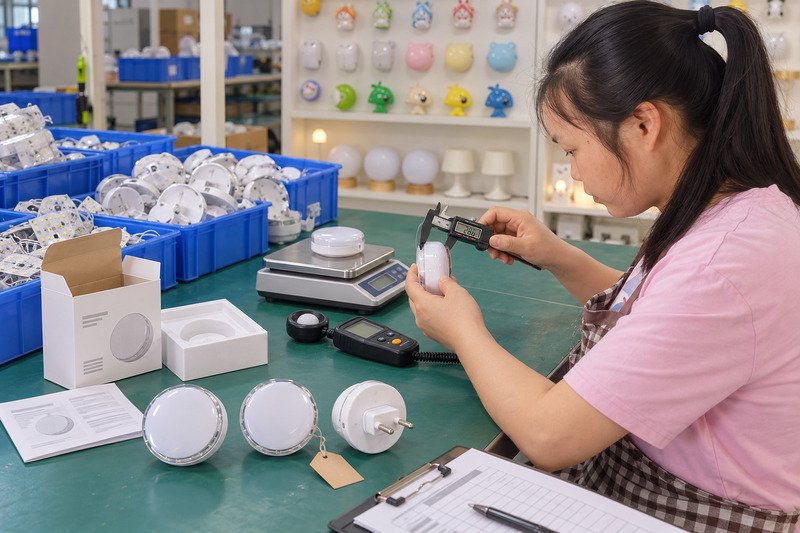
At Chocolamp, I want sample approval to give buyers a clear production reference. I separate what the purchasing team can inspect directly from what needs suitable equipment or qualified testing. I then connect both sets of information to a written specification that production and inspection teams can follow.
Why Is an Attractive Sample Not Enough to Approve a Bulk Order?
I can learn a lot from a sample’s appearance. But an attractive housing and a working LED tell me little about the materials or electronics inside.
I treat a sample as evidence of one product configuration at one point in time. I still need to confirm its materials, functions, electrical requirements and packaging. I also need a production-control plan because approving a selected sample does not show that every unit in a future shipment will match it.
I compare the sample with the promised specification
I start with the quotation and technical sheet. I want to know whether the sample represents the product being quoted or only a similar model.
A showroom sample may have a different plug, housing color or control function. That may be acceptable during early selection, but I record those differences before proceeding.
| What I can observe | What I still need to establish |
|---|---|
| I can see that the light switches on. | I need to confirm its rated supply and operating behavior. |
| I can inspect the visible finish. | I need the agreed material grade and color reference. |
| I can try the switch or sensor. | I need repeatable functional acceptance criteria. |
| I can examine the retail box. | I need the final artwork and transport-protection requirements. |
| I can approve the sample’s appearance. | I need a method for checking production against it. |
I separate product selection from order approval
I may use an early sample to choose a shape from our traditional night lights range. I would not automatically treat that sample as approval for a customized order.
If the buyer later changes the plug, color, logo or packaging, I review the changed version.
I also avoid assuming that a hand-selected sample proves production consistency. I need written specifications, agreed inspections and control over later changes. Those steps turn a promising sample into a usable purchasing reference.
Which Sample-Approval Mistakes Can Create Expensive Quality Claims?
I find that unclear approval records can make a quality disagreement harder to resolve. Both sides may remember the same sample but expect different production results.
I avoid approving samples from photos, a brief power-on check or a general “looks good” message. I record what was inspected, which configuration was tested and what remains open. I also identify meaningful variants and agree on measurable criteria before approving production.
I avoid relying on visual brightness alone
I compare samples under the same conditions. Room lighting, viewing distance and camera exposure can change how bright a night light appears.
I also distinguish a visual preference from a measured requirement. If brightness or color temperature matters to the order, I agree on a suitable measurement method rather than rely only on memory.
The approval mistakes I watch for include:
- I avoid testing only the simplest version when the order includes different functions.
- I do not accept a short demonstration as evidence of extended operating stability.
- I check the plug assembly instead of focusing only on the front housing.
- I test sensors in relevant light and movement conditions.
- I inspect the packed product, not just an empty retail box.
- I record unresolved issues before sending approval.
- I make sure the supplier knows which sample and artwork revision apply.
I sample variants according to their differences
I do not assume that one sample validates every combination in the order.
A different plug, voltage design, sensor circuit or packaging structure may need separate evaluation. A housing color change may need appearance approval and a review of any material implications.
I discuss a sample plan that covers those differences without requesting unnecessary duplicates.
I avoid vague acceptance language
I replace phrases such as “good brightness” or “strong packaging” with a clearer reference.
I might identify the approved sample, the measurement conditions and an agreed tolerance. For packaging, I would specify the structure and any agreed transport-test method.
I want both sides to know what constitutes acceptance before a claim arises.
How Do I Inspect an LED Night Light Sample Step by Step?
I use a fixed sequence so that appearance does not distract me from less visible requirements. I record findings as I go instead of relying on a final impression.
I check identification and specifications first, then appearance, materials, structure, lighting, functions and packaging. I arrange electrical and thermal evaluation where needed and review the relevant documents. I resolve differences against the quotation before approving the sample as a production reference.
I begin with identification, materials and structure
I assign each sample a reference number and record its model, revision and received date. I photograph the product and its labels.
I then compare it with the order requirements.
| Inspection item | What I confirm |
|---|---|
| Product specification | I check the model, rated input, power, plug and operating modes. |
| Appearance | I inspect color, finish, logo, joints, scratches and assembly. |
| Housing material | I request the polymer grade, recycled-content basis and any specified flame-retardant properties. |
| Plug and structure | I review pin dimensions, construction, fixing and intended socket compatibility. |
| Lighting | I compare output, color temperature, uniformity and glare under agreed conditions. |
| Functions | I check switches, sensors, timers and dimming against the operating sequence. |
| Heat performance | I arrange suitable operating-temperature evaluation and record abnormal behavior. |
| Packaging | I check fit, inserts, labels, barcode, instructions and protection. |
| Documentation | I match the supplied version with relevant specifications and test records. |
| Approval record | I identify the final reference, tolerances and outstanding conditions. |
I do not identify a plastic grade from appearance alone. I request supporting information and arrange verification where the order requires it.
I test lighting and controls repeatedly
I operate the sample at its specified supply conditions using suitable equipment.
For lighting, I check consistency between units and look for intermittent output. I do not use a phone camera as a complete flicker test. If flicker performance is part of the specification, I request an appropriate measurement.
For products from our multi-functional night lights range, I test every agreed mode separately.
My functional checks include:
- I repeat switch operations and confirm the correct mode sequence.
- I change the surrounding light level to check light-sensor behavior.
- I test motion activation from relevant approach directions.
- I measure the switch-off delay and check whether movement resets it.
- I confirm dimming and timer behavior where those functions apply.
I arrange electrical and thermal checks appropriately
I do not prescribe one universal operating duration for every night light. I agree on a screening period and obtain the applicable laboratory test plan where required.
I ask for temperature evaluation under defined conditions, including the supply, surroundings and installation position. Touch alone cannot establish safe operating temperatures.
I stop using a sample that shows smoke, deformation, intermittent arcing or other abnormal behavior and refer it for investigation. I do not open or probe a mains-powered product while it is energized.
I also leave pin-strength tests and electrical safety tests to qualified personnel using suitable procedures and equipment.
I inspect the complete packed product
I place the actual product, instructions and accessories inside the proposed package.
I check whether the plug presses against the box, whether the product moves excessively and whether the barcode remains readable.
Where transport testing is needed, I agree on the packed configuration and test method. I do not treat an informal drop from an arbitrary height as proof of shipping protection.
What Is the Difference Between a Standard, Customized and Golden Sample?
I use different samples for different decisions. Confusion starts when an early selection sample becomes the production standard without anyone confirming the changes made afterward.
I use a standard sample for initial evaluation, a customized sample to review requested changes and a golden sample as the final approved physical reference. I support that final sample with written specifications because appearance alone cannot record every material, component or performance requirement.
I identify the approval stage clearly
I label each sample according to its purpose. That helps buyers and production teams understand what it can establish.
| Sample type | How I use it | What I do not assume |
|---|---|---|
| Standard sample | I evaluate an existing model’s basic design and operation. | I do not assume it includes the buyer’s final customization. |
| Customized sample | I review requested colors, logos, functions or packaging. | I do not assume every detail is approved merely because it was submitted. |
| Golden sample | I establish the final agreed physical reference. | I do not treat it as a replacement for specifications or test evidence. |
I approve the exact configuration
I make sure a customized sample reflects the requested changes before calling it final.
For a buyer selecting children’s night lights, that could include the housing color, decorative details, switch function and branded packaging.
If the sample has a temporary label or unfinished package, I record the exception. I do not let a partial approval become permission to produce every remaining detail without review.
I retain identifiable matching references
I prefer the buyer and factory to retain matching approved units. I identify them with the model, revision, approval date and relevant signatures or approval records.
I also keep photographs and the associated specification files.
I agree on how the physical references will be stored. Samples can become scratched, dirty or discolored over time, so I do not rely indefinitely on an aging unit as the only color standard.
If a later change is approved, I update the reference and clearly mark the earlier version as superseded.
How Do I Turn Sample Approval into a Mass-Production Quality Standard?
I want the approved sample to guide production, not remain in a sales office drawer. The factory and inspector need accessible instructions that describe the same product.
I create a written approval record linked to the golden sample, specifications and artwork. I define tolerances, change-approval rules and inspection criteria. I then arrange production confirmation and pre-shipment checks so the team evaluates actual goods against the agreed standard.
I build an approval file that others can use
I include enough information for someone who did not attend the sample review to understand the order.
My approval file contains:
- I identify the model, configuration and sample reference.
- I record dimensions, weight and agreed tolerances.
- I attach material and component requirements where relevant.
- I include lighting and functional acceptance criteria.
- I identify approved artwork, labels and packaging files.
- I retain test records and documented exceptions.
- I record who approved the order and when.
I also resolve conflicts between documents. If the sample differs from the specification, I clarify which requirement needs correction before production.
I control changes before they reach the shipment
I require written approval before changes to agreed materials, components, structure, functions or packaging.
I want the supplier to explain the proposed change and its possible effect on performance, documentation, cost and timing.
I do not assume that an alternative component is unacceptable. I require an evaluation and approval before it replaces the agreed item.
I check production against the same reference
| Production stage | What I want confirmed |
|---|---|
| Before production | I confirm materials, components, artwork and packing instructions. |
| At the start of production | I compare initial units with the approved reference. |
| During production, where needed | I review relevant process and functional checks. |
| Before shipment | I arrange random inspection against the agreed criteria and sampling plan. |
I define defect descriptions and acceptance rules before inspection. I also identify checks that require full-unit testing rather than relying only on random sampling.
A pre-shipment inspection helps assess the finished lot. It does not guarantee that every unit is defect-free, just as sample approval does not establish compliance by itself.
Frequently Asked Questions
What Should Buyers Check First?
I start by matching the sample to the quotation and specification. I confirm the exact model, supply requirements, plug, functions and customization before assessing the finish.
How Long Should I Test a Sample Continuously?
I agree on the duration according to the product and test purpose. A brief power-on check is insufficient, but a fixed number of hours cannot establish every safety or reliability requirement.
Is One Sample Enough?
I do not use one unit to represent every configuration automatically. I request coverage of meaningful differences and agree on additional units where repeatability or destructive testing needs evaluation.
What Is a Golden Sample?
I use the term for the final approved physical reference. I identify it clearly and connect it with the written specification, packaging and approval records.
How Can I Reduce Differences Between Samples and Bulk Goods?
I define the materials and performance requirements, control changes in writing and arrange production checks. I also make the approved reference available to the factory and inspection team.
Does Sample Approval Replace Certification or Inspection?
I keep those tasks separate. Sample approval defines the agreed product, document review checks relevant supporting evidence, and production inspection evaluates the manufactured goods.
Conclusion
I approve samples against written requirements, retain a clear reference and check production against it. That gives buyers a practical basis for managing quality before shipment.

