
I know adding a logo sounds simple. But unclear minimums, packaging revisions and missing approvals can turn a small private label order into an expensive stock commitment.
I recommend starting private label night lights with an existing model, limited variants and a clearly defined packaging plan. Before ordering, I confirm the MOQ per model, color and packaging version, then agree on samples, artwork, costs and production timing. A low total MOQ alone does not define a manageable project.
At Chocolamp, I approach a first private label order as the starting point for repeat business. I want the buyer to receive a product they can sell, explain and reorder with confidence. That means connecting the branding idea with production requirements before we settle the final quantity.
Why Do Private Label Night Light Orders Become More Complex Than Expected?
I often find that “just add our logo” describes the branding goal, but leaves most production decisions open. Those decisions can affect both cost and timing.
I separate a private label project into product, branding, packaging and delivery requirements. A change to the housing color, plug, instructions or retail box may create another approval or production requirement. I define those details early so the quotation reflects the product the buyer actually expects to receive.
I define what private label means for the order
I do not assume that every buyer wants a different product. Some buyers want an existing night light in their own packaging. Others want a custom housing color, printed logo or different light function.
I first ask which changes help the buyer’s sales channel. That keeps the project focused.
For example, a buyer reviewing traditional night lights may find that an existing design already fits the intended price point. In that case, branded retail packaging may provide enough differentiation for the first order.
| Project area | What I clarify before quoting |
|---|---|
| Product | I confirm the model, function, plug, housing color and light color. |
| Branding | I confirm where the logo appears and how it is applied. |
| Retail packaging | I agree on the structure, printing, inserts and labels. |
| Instructions | I identify the required content, languages and approval responsibility. |
| Shipping | I confirm carton packing, shipping marks and delivery terms. |
I connect each change to a practical requirement
I look at the work behind a request rather than its apparent size.
A new box may need a dieline, a fit check and print approval. A translated manual may need content review. A different plug may require a separate product version and supporting documentation review.
I also distinguish private labeling from exclusivity. Putting a buyer’s brand on an existing model does not automatically give that buyer exclusive rights to the design.
If exclusivity matters, I discuss its scope separately. I want the agreement to identify the product, territory, period and other relevant conditions rather than leave either side with an assumption.
Which MOQ and Packaging Mistakes Do First-Time Buyers Often Make?
I know buyers want one clear minimum quantity. But a single number can hide several separate minimums and leave the planned assortment impossible to produce as quoted.
I ask whether MOQ applies per model, housing color, plug version, logo process or packaging design. I also check the packaging supplier’s minimums. A total order of 2,000 pieces does not automatically mean the buyer can divide it freely across multiple products, colors and printed boxes.
I request the quantity breakdown first
I want to see the proposed order by version, not just as a total.
A buyer might request two models, two colors and two languages. Depending on the combinations, that can create several separate stock items and packaging versions.
I check whether those splits fit the production plan before confirming a minimum.
The mistakes I help buyers avoid include:
- I check that a model-level MOQ has not been mistaken for an order-wide MOQ.
- I confirm whether two housing colors can share the quoted quantity.
- I ask whether each language needs separate printed packaging.
- I check whether different plugs require separate packing instructions.
- I confirm whether packaging minimums exceed the product quantity.
- I identify who pays for any approved surplus packaging.
I do not assume unused packaging solves the MOQ problem
I may review the option of printing more boxes than the first shipment needs. But I would only proceed after agreeing on the cost and handling of the balance.
Unused packaging can become obsolete when artwork, product details or market requirements change. Storage also needs a clear agreement.
| Question I ask | Why I ask it |
|---|---|
| Who owns the unused packaging? | I want its ownership and payment basis recorded. |
| Where will it be stored? | I need an agreed storage arrangement. |
| How long will it be held? | I want the buyer to understand any time limit. |
| What happens after an artwork change? | I need responsibility for obsolete stock to be clear. |
I also allow time for packaging approval. A low product MOQ does not remove the need to prepare artwork, check fit and approve the final version before production.
How Do Product and Packaging Customization Affect MOQ?
I evaluate customization by the changes it creates in materials, setup and production. A small visual change can require more preparation than a larger branding change on packaging.
For many of our existing night light models, private label projects can start from 2,000 pieces, depending on the model, packaging format and customization requirements. I confirm the exact quantity after reviewing the project. Custom colors, separate print versions or new development may require a different minimum and cost structure.
I start with the existing product platform
I usually recommend evaluating an existing model before discussing new tooling.
That approach lets the buyer assess the product, packaging and market response without immediately committing to a new housing or electrical design.
I still review the selected configuration and relevant documents. An existing model does not remove the need to confirm that the supplied version matches the destination market.
| Private label level | Typical changes I review | How I assess MOQ | Buyer situation I would consider |
|---|---|---|---|
| Basic branding | I review a logo label, suitable product printing or branded packaging label. | I check the marking process and existing packaging availability. | I consider this for a focused market test. |
| Custom retail packaging | I review a printed blister card, color box, manual and barcode label. | I check each printed item’s setup and minimum quantity. | I consider this for a defined retail launch. |
| Product customization | I review housing color, light color, function or accessories. | I assess material batches and production changes. | I consider this when the buyer needs a clear product difference. |
| New product development | I review new tooling, housing or electronics. | I assess development work, validation and production requirements. | I consider this after demand and budget are established. |
I separate one-time charges from unit costs
I want buyers to understand what they will pay again on a reorder.
A tooling charge, artwork service or production setup may be quoted separately from the unit price. Some costs may recur when a design changes.
I therefore ask for a cost breakdown covering:
- I identify sample and sample-shipping charges.
- I confirm any tooling or setup charges.
- I state what the quoted unit price includes.
- I identify separately charged packaging or labels.
- I clarify which costs may apply again on a reorder.
I also check whether the proposed branding method suits the product. I do not promise that every housing accepts printing, laser marking or adhesive labels equally well.
For buyers selecting children’s night lights, I would review logo placement alongside the decorative design. A large logo can interrupt the appearance without adding useful shelf appeal.
Which Packaging Option Fits Your Channel and Budget?
I do not choose packaging by appearance alone. A retail package also needs to hold the product securely, communicate clearly and fit the buyer’s distribution method.
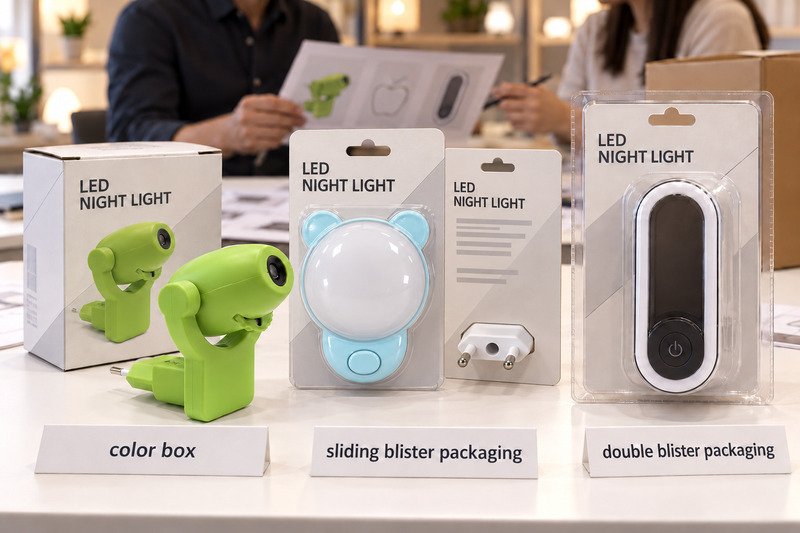
I compare blister packaging, color boxes and neutral packaging with branded labels against the sales channel. Blisters can support product visibility and hanging displays. Color boxes offer more space for brand communication. Neutral packaging can simplify testing, but I still check protection, labeling and the total packed cost.
I connect the format to how the product is sold
I ask where the buyer expects customers to encounter the product.
A physical retailer may need a hanging pack with the product visible. An online seller may prefer a compact box with clear identification. A gift channel may place more value on presentation.
| Packaging option | Where I would consider it | What I check before approval |
|---|---|---|
| Blister with printed card | I consider it for hanging retail displays and visible product presentation. | I check retention, sealing, hanging strength and product fit. |
| Printed color box | I consider it for branded retail ranges, online sales and gift-oriented presentation. | I check board, inserts, printing and product protection. |
| Neutral box with branded label | I consider it for a limited market test or simple distributor program. | I check label placement, adhesion and required information. |
I distinguish the retail pack from the shipping pack
I do not assume a color box is ready for individual parcel delivery. The product may need an insert, protective wrapping or an outer shipping carton.
I also consider the space occupied by the plug. A box that looks compact in an artwork file may need more depth once the actual product is placed inside.
Before approval, I review:
- I check that the plug does not press against a vulnerable surface.
- I check that the product does not move excessively.
- I confirm that the barcode remains readable after assembly.
- I check that the package accommodates the instructions.
- I review the packed dimensions and master-carton arrangement.
- I agree on suitable transport checks for the intended shipping route.
I compare the total packaging effect
I do not assume that the cheapest printed package creates the lowest overall cost.
A larger package can increase shipping volume and storage needs. A weak package can increase damage. An overly complex structure can add assembly work.
I want the buyer to compare the complete packed product. That gives a more useful budget than comparing the box price in isolation.
How Can Buyers Plan a Lower-Risk First Private Label Order?
I prefer a first order that produces clear sales information. Too many models and packaging versions can make the results harder to interpret and the stock harder to manage.
I recommend choosing an existing model, limiting variants and agreeing on one clear specification before ordering. I confirm the product sample, packaging structure, artwork, quantity breakdown and production starting conditions. I then use sell-through, complaints and reorder demand to decide which parts of the range deserve expansion.
I keep the first range focused
I ask buyers to give each model a clear role.
A simple night light may cover the opening price point. A product from our multi-functional night lights range may offer a distinct upgrade. I would not add several similar versions without a clear channel need.
I also assess language versions carefully. A shared package may reduce print splits where it suits the destination requirements and leaves the information readable. I do not force several markets into one design simply to save printing cost.
I approve the product and packaging together
I want the buyer to see how the actual product fits the proposed package.
A digital proof helps check layout and text. It does not fully demonstrate fit, material feel or the final printed color. I discuss which physical samples or proofs the project needs.
| Checkpoint | What I confirm before production |
|---|---|
| Product model | I identify the existing model or agreed development scope. |
| Quantity basis | I record the quantity per model, color and packaging version. |
| Branding | I confirm the method, location, size and artwork. |
| Packaging | I approve the structure, material and product fit. |
| Artwork responsibility | I identify who provides logos, barcodes, translations and warnings. |
| Market requirements | I confirm the destination, plug, markings and relevant documents. |
| Sample approval | I identify the approved product and packaging references. |
| Lead time | I state which approvals and payments start the production period. |
| Master carton | I confirm quantity, dimensions, weight and shipping marks. |
| Reorder basis | I record the specification that future orders should follow. |
I make the next order easier to evaluate
I keep the approved files and sample references linked to the order.
I also encourage buyers to record feedback by version. If one color sells slowly, that information should remain separate from the model’s total sales.
Before discussing expansion, I review sales pace, returns, retailer comments and remaining stock. I want the next order to reflect actual demand rather than simply repeat every first-order choice.
Frequently Asked Questions
What Is the Typical MOQ for Private Label Night Lights?
For many of our existing models, I can evaluate projects starting from 2,000 pieces. I confirm the actual minimum from the model, quantity split, packaging and customization requirements.
Is MOQ Calculated per Model, Color or Packaging Design?
I check each of those separately. A supplier may accept the total product quantity while requiring a higher minimum for one color or printed packaging version.
What Packaging Options Can I Discuss With Chocolamp?
I can review blister cards, color boxes and neutral packaging with branded labels. I confirm availability and suitability for the selected model before quoting.
Can I Use Custom Packaging for a Small Trial Order?
I assess this project by project. I check the product quantity and packaging minimum, then explain any setup costs or surplus packaging before the buyer commits.
What Files Do I Need for Branded Packaging?
I normally request an editable logo, brand colors, approved text, barcode data and any required translations. I also clarify who prepares the print-ready artwork and approves the final files.
How Should I Start My First Order?
I suggest sending the target market, preferred model, estimated quantity, branding idea and sales channel. I can then review a practical product and packaging combination before developing the final quotation.
Conclusion
I plan private label orders around clear specifications, manageable variants and approved packaging. A focused first order gives buyers a stronger basis for reorders and expansion.

